
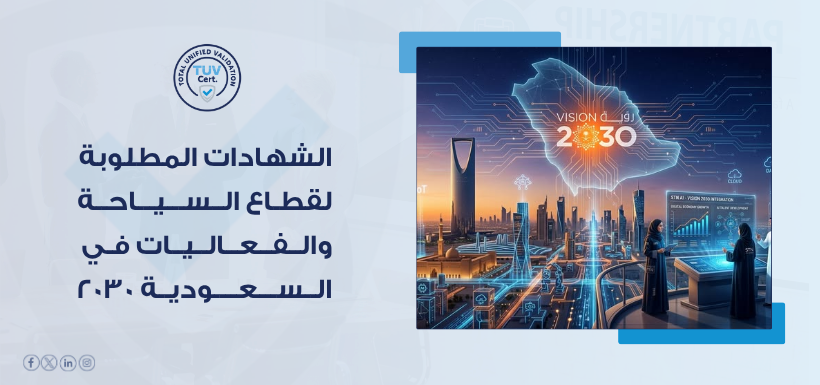
iso-certificates-tourism-events-sector-saudi-arabia-2030
Is Your Company Ready to Serve Millions of Visitors? TUV Puts Its Readiness to the Test
On ordinary days, a minor complaint may pass without much attention, a delayed supplier may not cause a crisis, and teams may handle congestion through temporary solutions…
But when cities fill with visitors and hotels, restaurants, transportation services, and event venues operate at full capacity, a small weakness can turn into a scene witnessed by the entire world.
So, can your company deliver the same quality to visitor number ten as it does to visitor number one million?
As Saudi Arabia’s preparations for the 2034 FIFA World Cup accelerate, the competition will not be limited to attracting visitors. It will also be about serving them safely, efficiently, and quickly, while delivering an experience that matches the scale of the event.
This is where ISO certifications for the tourism and events sector become more than documents added to a corporate profile.
They are management systems that help organizations control operations, manage risks, protect employees, reduce environmental impact, and maintain service continuity under pressure.
There is no room for improvisation:
Crowds require smooth movement.
Services require consistent quality.
Suppliers require oversight.
And a single incident can erase years of reputation within minutes.
That is why tourism sector quality standards give organizations a common operational language that turns the promise of an “exceptional experience” into responsibilities, performance indicators, and evidence that can be tested.
With TUV, the journey begins with a question that leaves no room for complacency:
Does your system continue to work when visitor numbers rise and pressure doubles—or does it only appear strong when everything is calm?
ISO certifications for the tourism and events sector can help your company build readiness that extends far beyond event day, while Saudi Arabia’s preparations for the 2034 FIFA World Cup are pushing the market toward a new level where inconsistent service, delayed safety measures, and unpredictable visitor experiences have little room.
The world will not see your internal procedures…
It will see the quality you deliver, the speed of your response, and your ability to turn tourism sector quality standards into an experience that allows every visitor to leave with an impression worthy of Saudi Arabia.
Four Certifications That Can Open the Door to Major Projects: How Do You Create an Event That Does Not Let Its Guests Down?
An event begins long before the first visitor arrives.
It begins when the organizer selects a supplier, plans crowd routes, tests emergency exits, calculates energy consumption, and decides what will happen if the booking system goes down, transportation is delayed, or waste levels suddenly double.
Success is not measured by an impressive opening moment alone.
It is measured by the team’s ability to maintain quality throughout the event, protect employees and visitors, manage resources responsibly, and leave the site in better condition than it was before.
This is why ISO certifications for the tourism and events sector become systems that shape the event behind the scenes—giving every decision a standard, every risk an owner, and every outcome evidence.
As Saudi Arabia’s preparations for the 2034 FIFA World Cup accelerate, it will not be enough for a company to say that it can manage crowds, operate hospitality services, or run large-scale venues.
The market will look for organizations capable of demonstrating readiness and applying tourism sector quality standards under the pressure of visitor volumes, tight schedules, and global expectations.
Four certifications stand out here, each with a different role:
ISO 20121 for event sustainability,
ISO 9001 for quality,
ISO 45001 for occupational health and safety, and
ISO 14001 for environmental management.
ISO 20121: The Conductor That Makes Sustainability Part of the Event
An event may look successful on stage while leaving behind tons of waste, wasted resources, complaints from the local community, and suppliers selected without clear criteria.
In such cases, sustainability is not a media campaign. It becomes a way of managing the event from planning through closure.
ISO 20121 helps establish an Event Sustainability Management System that enables organizations to assess the economic, social, and environmental impacts of their decisions.
It does not require organizers to eliminate every impact. Instead, it encourages them to identify, measure, and reduce those impacts in a structured way that can be continually improved.
The standard supports areas such as:
-
Identifying parties affected by the event and understanding their needs.
-
Selecting suppliers according to clear sustainability criteria.
-
Reducing waste of materials, energy, and food.
-
Supporting accessibility and inclusion in the attendee experience.
-
Managing the event’s impact on the community and surrounding location.
-
Setting measurable objectives before the event begins.
-
Reviewing results after the event has ended.
Within ISO certifications for the tourism and events sector, ISO 20121 gives organizers a broader perspective. It does not view an event as merely a few days on the calendar, but as a chain of decisions that begins with the contract and ends with the legacy the event leaves behind.
ISO 9001: Quality That Does Not Change When the Seats Are Full
At a small event, a manager may be able to step in personally and resolve a registration error or a delayed hospitality service.
But at large-scale projects, the experience cannot depend on individual heroics.
Organizations need stable processes that prevent service inconsistencies between one entrance and another, one day and the next, or one supplier and another.
ISO 9001 helps establish a Quality Management System that connects visitor requirements with processes and outcomes.
It can be used to control the entire attendee journey—from purchasing a ticket and arriving at the venue, through entry and service delivery, to departure and complaint handling.
It strengthens tourism sector quality standards through:
-
Clearly identifying customer and visitor requirements.
-
Standardizing service delivery procedures.
-
Establishing performance indicators.
-
Controlling suppliers and subcontractors.
-
Recording problems and analyzing their root causes.
-
Monitoring visitor and partner satisfaction.
-
Improving procedures based on data.
ISO 9001 does not mean that errors will never occur.
Instead, it prevents the organization from treating an error as an isolated incident that is forgotten once the day is over.
Every deviation becomes a lesson, every complaint becomes information, and every result becomes an opportunity to improve the next event.
As Saudi Arabia’s preparations for the 2034 FIFA World Cup progress, the ability to deliver a consistent experience becomes part of the competitiveness of companies operating in hospitality, transportation, tourism, and event services—not merely an internal quality management objective.